
What happens when a domain expires? Most people treat their domain name like a utility bill – it renews automatically, the reminder lands in the inbox, and nobody thinks much about it until something goes wrong.
The problem is that “something going wrong” with a domain name isn’t a minor inconvenience. Depending on how far down the expiry timeline things get, it can mean a website that’s completely offline, email that stops working, years of SEO authority wiped out, or a domain that gets picked up by a cybersquatter within hours of dropping.
Understanding what actually happens at each stage of expiry – and how monitoring fits in – is genuinely useful for anyone managing web infrastructure. So, let’s walk through it properly.
The Expiry Timeline: What Actually Happens
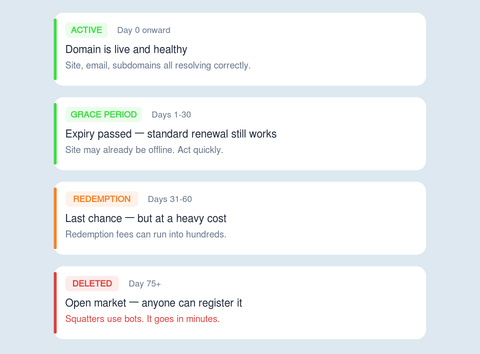
When a domain reaches its expiry date, it doesn’t vanish immediately. Most registrars follow a structured grace period process:
Day 0 Expiry: The domain technically expires. Depending on your registrar, the site may stay live for a short window.
Days 1-30 Grace Period: Most registrars allow renewal at standard cost during this phase. Your site may go offline.
Days 31-60 Redemption Period: The domain can often still be reclaimed, but at a significantly higher “redemption fee” – sometimes hundreds of pounds or dollars.
Day 75+ Deletion & Release: The domain is released back to the open market. Anyone can register it.
That last stage is where things get dangerous. Cybersquatters and domain investors use automated tools to snap up expired domains with existing traffic, backlinks, and brand recognition. Once gone, getting your domain back can be costly, slow, or simply impossible.
Why Registrar Reminders Aren’t Enough
Registrars do send renewal reminders – but they’re not a reliable safety net:
- Reminders go to the email address registered at the time of purchase, which may be an old inbox, a former employee’s address, or a shared account no one actively monitors.
- Spam filters catch them. They get buried. They get ignored.
- If you manage domains across multiple registrars (common for agencies), reminders come from different sources with inconsistent timing.
- Auto-renew can fail silently if a payment method expires.
For anyone managing more than a handful of domains, a spreadsheet and a prayer is not a monitoring strategy.
The Risks Go Beyond Downtime
An expired domain doesn’t just take a website offline. Depending on how the domain is used:
Email stops working – MX records tied to an expired domain mean no inbound or outbound mail.
Subdomains go dark – Any subdomain (staging environments, client portals, API endpoints) tied to the root domain becomes inaccessible.
SEO equity is lost – Years of backlink authority can be destroyed in days once a domain is dropped or pointed elsewhere.
Brand hijacking – A bad actor re-registering your expired domain can impersonate your business, send phishing emails from your domain, or damage your reputation.
What Proactive Domain Monitoring Looks Like
The fix is straightforward: stop relying on registrar emails and start using a monitoring platform that watches your domains independently.
Sentinel’s Domain Monitoring tracks WHOIS data continuously across your entire portfolio. It detects:
- Approaching expiry dates – with configurable alert windows (30, 14, 7, and 1 day out)
- Registrar changes that could indicate an unauthorised transfer
- Ownership changes or WHOIS data modifications
Alerts are delivered through the channels your team actually uses – Slack, Microsoft Teams, Discord, email, SMS, or phone – so the right person is notified at the right time, automatically.
Practical Tips for Agencies Managing Client Domains
If you’re a web agency or freelancer managing domains on behalf of clients, the stakes are even higher. An expired client domain is a client relationship at risk.
- Centralise your portfolio: Use a single dashboard to track all domains regardless of registrar. Sentinel gives you this out of the box.
- Set multi-stage alerts: A 30-day warning gives you time to chase the client for payment. A 1-day warning means act now.
- Audit WHOIS contacts: Ensure monitoring alerts go to your team, not just the registered domain contact (which may be outdated).
- Document ownership clearly: Know which domains you manage vs. which the client manages directly – and monitor both.
Wrapping Up
Domain expiry is completely avoidable. It doesn’t take technical skill or a big budget – just a monitoring setup that watches things for you and gives you enough notice to act. With Sentinel, every domain gets tracked continuously. You’ll hear about expiry risks weeks out, get flagged on any suspicious WHOIS changes, and have everything in one place.
Don’t wait for a client to call you. Know first.
Start monitoring your domains with Sentinel → https://senti.solutions/pricing/